
Words usually come easily to me. I find that descriptions of places flow easily for me and that I can relatively easily convey the sense of a place. I've also found on many an occasion that I have a strange relationship with the morose. I do not find death in and of itself to be depressing and I find trials and pain to have their own sorrowful beauty. This is not to say that I enjoy pain and death, but only that death and pain themselves do not scare me nor do they make me sad.
Hiroshima shook me.
Death ending a life well-lived, or nobly-lived is not a scary concept. Death as part of the very definition of what it is to be alive and as an affirmation of that life is beautiful. The way you see death in Hiroshima; death brought about swiftly and with such horrific, mind-boggling, destructive, and impersonal force is probably the most terrifying and hearth-wrenching thing I have ever encountered or even fathomed in my short life.

You surely know the story. You are probably aware of the debates surrounding it as well. I'm going to present my wanderings in Hiroshima entirely on what I saw and describe my experiences. The trip was fun, and very much worth it, but it was not easy. Nor is trying to find any words to describe the feeling of being there.
The journey started WAY to early in the morning on a Saturday as about a billion gaijin attempted to cram themselves into the public bus running to Hirakatashi-eki at about 6:00AM much to the dismay of every other person trying to ride the bus that day. Professor Paul Scott (teaching two of my classes) puts this trip together, so there were about 70 of us in all going.
We made our way through the trains to Shinosaka station where we transferred from the all too familiar subway system to the Shinkansen line, more popularly known around the world as the Japanese "bullet train".

The shinkansen is pretty cool to ride, but not really anything amazing once you're on board. I met some cool people and ended up riding next to the professor the whole way there as we argued about cars. Once we got there my little group decided to split up: the girls went to McDonalds and then rode a tram car to the museum, while my friend and I wandered there by foot and grabbed some dried fish for lunch. This made for a much more immersive and interesting experience of the city itself before we got to the museum.
 The Japanese have these awesome manhole covers down to an art.
 The local baseball team is the Carp(s?). The Hanshin Tigers are so much better though.
 Just for something in the way of geographic knowledge, Hiroshima is actually a city in a delta. There are four rivers running through the city out to the bay, cutting the city into huge islands.
This is the monument to the nurses and doctors who died as a result of radiation sickness after the bombing of Hiroshima.
 This is another monument that stands just across the street from the entrance to the museum proper. I couldn't get a good pic of the whole thing, but it's inscribed with the word for peace in several languages.
After this we wandered inside and saw a very small portion of the museum, essentially the part that explained the history of Hiroshima up until August 6th. Thanks to not a small number of classes in Asian/Japanese/Chinese history/politics/economics this was review for me, but interesting nonetheless. At this point we went down to the basement for the real reason I would head on a trip with 70 other gaijin and that is to experience something I wouldn't otherwise get to experience.
I got to hear an atomic bomb survivor speak. Some of the survivors of Hiroshima and Nagasaki are still speaking to this day, some of them even touring around the world. The woman who spoke to us had been to Missouri recently to speak to high-school students in the states. She described to us in (gruesome) detail her experience, her situation, and the way she survived. It was very powerful, and something I am glad I got to hear from somebody who was there. She was very kind and spoke to us one on one afterward. I can't personally with any real effect say what she said, and the information is all out there, albeit likely in a less personal form if you should want it. Needless to say it was powerful and gruesome.
After that we went through the museum.
 This T-shaped bridge was the aiming point of the bomb. It actually detonated only 800 meters off target.
 Before and after aerial photos of Hiroshima.
 Emergency medical treatment being applied at this point only 2-hours after detonation. At this point the complete lack of medical personnel, supplies, and even water meant that the treatment for burns was cooking oil, if it could be found.
 The red-cross hospital in Hiroshima.
This part of the museum is largely historical. It presents photos of the effects, historical data and visuals that bring the power and scale of an atomic weapon into perspective. It also puts forth the history of atomic weapons since WWII, and the current status of nuclear-armed nations. Then there's a gift shop, and short walk to the other building of the museum. The second half of this experience is not for the feint of heart.
 This wax sculpture was made using the descriptions given by survivors of those who were close enough to the blast to be most directly affected by the heat and radiation, but far enough away to survive. Their skin literally melted off their arms.

 The shadow of a man sitting on this stoop at the moment of detonation faded quite a bit with time, but has since been moved indoors to preserve it.
 More solid objects left better defined shadows.
I didn't take many photos inside the museum.


This memorial in particular is for Sadako Sasaki


We sat in a nearby rest-house and folded paper cranes. Even a few local folks joined us. Then we left ours and visited the atomic bomb dome.
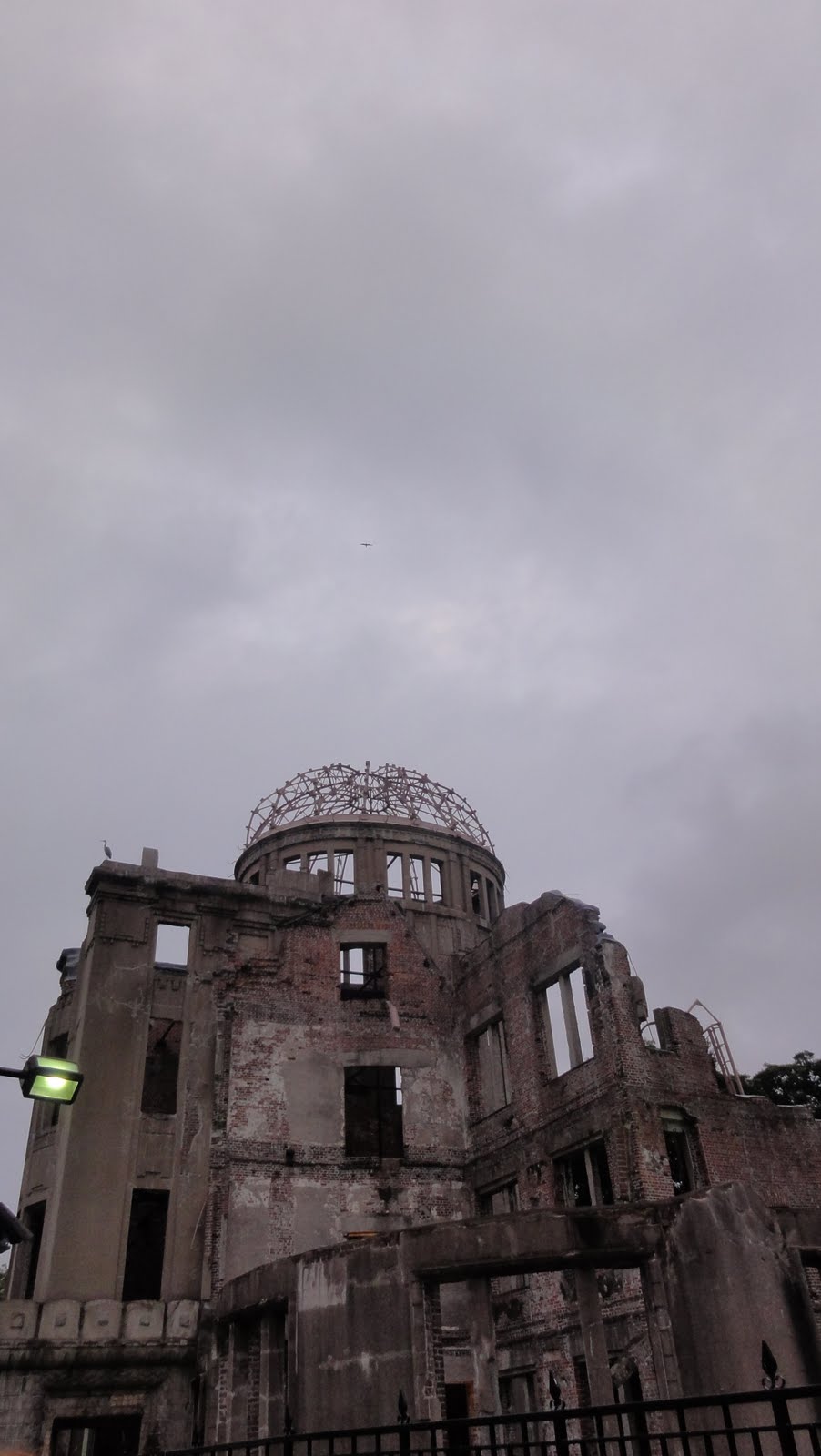

This building was the closest to the hypocenter to survive at all intact. It's been preserved in exactly the state it was in on August 6, 1945 and as such has become a hallmark image of that day.
From here we decided to find some food, wander about and turn in. My friends had to check into their hostel and I had to figure out where I was sleeping so we ate at a shop near a place that had this standing out front:
 which was only mildly disturbing. The food was delicious, as it always is here.
Though I was somewhat worried about where I'd be sleeping that night, I had nothing to fear! Near the station I found a place called Futaba. If you are ever traveling (preferably alone) in Japan and you're on a budget/don't ever remember to make reservations or plans, then you should find an internet cafe. For 2100 yen (like $25 US) I got a semi-private cubicle with a big comfortable reclining chair, a computer with fast internet access, a huge manga library, unlimited soft drinks and ice cream, access to a shower room and bathroom all for 12 hours. It's pretty much the best deal in cheap traveling ever. Just remember to pack your face mask, because they don't shut out the lights. An alternative to this is karaoke bars (one of my favorites being Ring) which offer very similar deals.
My apologies for having such a serious and heavy post, but I promise the next will be uplifting for the next morning I awoke and hauled my fat ass up a mountain! The pictures are spectacular I promise, and you shall want to see them.
Stay tuned for next time: Miyajima
Until then, stay stoked!


